

- To always apply intravenous heparin before arterial clamping (except patient has a history of heparin induced thrombopenia (HIT)
- To understand the important differences between ‘clamping’ devices (e.g. DeBakey vascular clamp vs Overholt clamp)
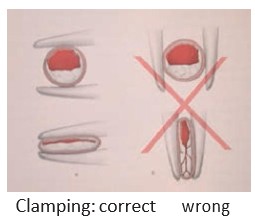
- To apply arterial clamps correctly (pay attention to orientation of calcified plaques)
- To perform arteriotomy correctly (Nr. 11 scalpel (upwards!) and Potts scissors)
- To handle forceps correctly to avoid damage to arterial walls (don’t squeeze)
- To position needle correctly in the needle holder (usually 1/3 to 2/3; 30° forward)
- To adopt an ergonomic hold of instruments and position of body and arms
- To stitch correctly through arterial walls (perpendicular direction)
- To direct stitches correctly: from inside out in arteries and towards outflow (to avoid dissection); from outside in in prostheses (and, if necessary, in arteries towards inflow
- To never grasp sutures with instruments (it can be damaged or break)
- To always evert the arterial wall (to avoid contact of blood stream with adventitial connective tissues)
- To understand pros and cons of interrupted sutures vs running sutures
- To understand optimal placement of the suture in running sutures to ensure a tight suture (forward direction of every stitch, shortest distance between stitch in and stitch out)
- As assistant: where to hold a suture to secure suture line, avoid loops of the remaining suture but give enough leeway for the next stitch (45% to 55% principle)
- As assistant: to pull the suture in direction of the stitch, and not backwards (to avoid pursestring effect
- As assistant: to let the surgeon adapt the tissues first before pulling the suture (to avoid suture hole bleeding)
- To always flush before closure, knotting and declamping
- 2x transverse / 2x longitudinal arteriotomies. Close both arteriotomies with both techniques: interrupted and running sutures, respectively
- Handling of arterial wall: grasp only adventitia with your forceps
- Proper clamping of the artery: pay attention to plaque, use a vascular clamp, adjust the force of the clamp, don’t forget to give heparin before clamping!
- Arteriotomy: use a s scalpel blade Nr 11, stab incision holding blade upward
- Extend arteriotomy using Potts scissors
- Handling of artery with forceps: don’t squeeze intima, use forceps as counterforce during the stitch, hold only adventitia
- Hold the needle holder correctly
- Position of needle correctly
- Stitch all wall layers with a perpendicular stitch (no tangential stitches)
- Direction of stitch inside-out (in arterial walls to avoid dissection)
- Interaction between needle, needle holder and forceps: pick up needle, plan next stitch
Control of learning targets
- Eversion
- Regularity of stiches
- Tightness of suture


Post time: Jun-15-2026